Gulfi: Redefining Nero d'Avola and Sicilian Cru Terroir
Gulfi is a leader in Sicilian wine and a nero d'avola specialist
They’ve helped elevate how Nero d’Avola is understood — not just as big, ripe fruit, but as a wine capable of nuance, minerality, structure, and aging.

Source: Coppiera Travel Archives
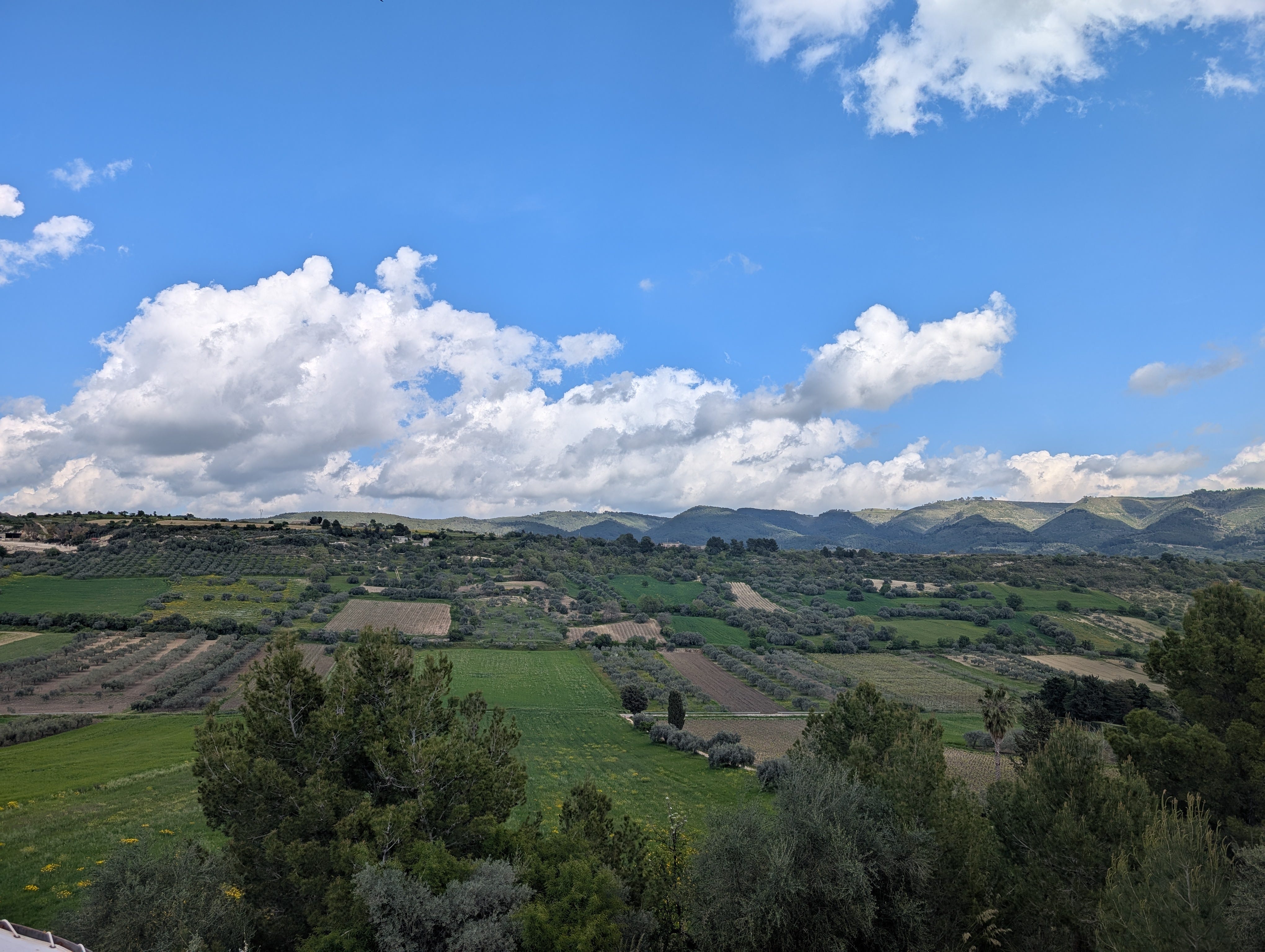
Located in the foothills of the Iblei Mountains, the road to Gulfi winds through the countryside with intermittent, peekaboo views of the sea. Perched along a ridge, the winery overlooks the expansive Ippari River valley below — a breathtaking landscape that stretches all the way toward the Mediterranean. This valley forms the historic heart of Cerasuolo di Vittoria DOCG, Sicily’s first and still only DOCG appellation. By evening, cool sea breezes drift inland, tempering the warmth accumulated during the day.
Although Gulfi was officially founded in 1996 by Vito Catania, the estate’s connection to Sicily’s agricultural traditions is immediately apparent. Greeting visitors at the winery entrance is a massive historic Sicilian olive press, or frantoio. Constructed from wood and stone, the structure consists of a large circular basin where olives were crushed alongside the heavy wooden beam mechanism once used to extract olive oil. For centuries, presses like this were fixtures throughout rural Sicily.

Ancient olive press. Source: Coppiera Travel Archives
Today, Gulfi has grown into a medium-sized estate producing approximately 200,000 bottles annually. Roughly 70% of Gulfi’s production is exported, with major markets including the United States, Japan, and Germany. The winery has built its philosophy around indigenous grape varieties, minimal-intervention winemaking, and a strong commitment to terroir. Tradition, respect for the land, and transparent site expression sit at the center of its identity.
Viticulture
The estate is fully organically certified, meaning they strictly avoid chemical herbicides, synthetic pesticides, and artificial fertilizers across their properties. In addition to their organic certification, their modern vineyard practices heavily lean into biodynamics—focusing on biodiversity, natural vineyard balance, and minimal intervention to preserve the raw expression of their terroir.
Gulfi farms three primary vineyard areas:
-
Pachino / Val di Noto (22 ha)
Historically one of Sicily’s most prized zones for Nero d’Avola, this area includes parcels of alberello (head-trained) vines cultivated according to ancient Mediterranean traditions dating back to Greek times. Yields here are extremely low, sometimes producing only five clusters per vine. -
Monti Iblei / Chiaramonte Gulfi (35 ha)
Situated at elevations between 420–450 meters, these vineyards contain older plantings of Nero d’Avola, Frappato, Carricante, and Chardonnay. -
Etna / Randazzo (2 ha)
Located on the northern slopes of Mount Etna at elevations between 800–850 meters, these vineyards are planted primarily to Nerello Mascalese and Nerello Cappuccio.
All vineyards are dry-farmed without irrigation. However, the extreme heat of late July 2024 forced Catania to establish an emergency water reserve system — a reflection of the growing climatic pressures facing Sicilian viticulture.

View from Gulfi Winery. Source: Coppiera Travel Archives
Winemaking
In the cellar, Gulfi adopts a restrained approach intended to preserve the character of each grape and site rather than shape the wines toward international stylistic norms. Fermentations rely exclusively on native yeasts and take place in temperature-controlled stainless steel tanks. Varieties are vinified separately, particularly for Cerasuolo di Vittoria, since Nero d’Avola typically ripens roughly a week earlier than Frappato.
Depending on the cuvée, élevage occurs either in French barriques or in large Slavonian oak casks. Interestingly, despite being firmly rooted within the Cerasuolo di Vittoria DOCG, fully half of Gulfi’s production consists of single-contrada wines made entirely from Nero d’Avola. At Gulfi, Nero d’Avola is not simply another variety — it is the estate’s foundation and defining identity.

Gulfi Barrel Room. Source: Coppiera Travel Archives
Gulfi is widely regarded as one of Sicily’s benchmark producers. The winery is frequently credited with helping elevate perceptions of Nero d’Avola by emphasizing old vines, site specificity, and nuanced expressions of the grape rather than the broad, overly ripe style that once dominated Sicily’s export image. Their commitment to traditional viticulture, organic and biodynamic farming, and minimal-intervention winemaking aligns naturally with global interest in authenticity, sustainability, and a strong sense of place.

Gulfi Tank Room. Source: Coppiera Travel Archives
TASTING
Overall the wines are rich and powerful but with distinct structure. Nero d’avola seems to have spiced undertones like sassafras and sandalwood. There is a musky note, powdery finesse to its tannins, and a floral perfume all of which are reminiscent of Malbec, to me.
2024 Elora San Lorenzo Rosario (from Pachino area) - Saline, chalky, hint of volatility, crisp acidity, rustic texture and pleasant raspberry, strawberry finish
2023 Valcanzjria (65% chard, 35%carricante) - Tropical, melon, mineral edge, plush mouth feel, medium acid, silky MLF feel
2017 Pino - aromatic, garnet-ish, needs a little time - tannins still a touch rusty, but great bright mouth feel, cherries, cranberries, red plums, fresh and bright, less complex than Reseca
2021 Reseca (Etna, Nero Mascalese) - 2yr in barrel, mixed red fruits, pronounced smooth tannins interwoven with fresh acid, dried plum, dried cranberries, subtle spice
**2021 Carjacanti - melon, chalk, Granny Smith, sour lemon custard, high acid, rich mouth feel, long finish (excellent), move over Rombauer, this is what cougars should be drinking!
2020 Cerasuolo di Vittoria Classico - sassafras, spice, sandalwood, Morello cherry, prunes, - big tannins, high but integrated tannins, persistent sassafras finish
2022 Nerojbleo - sassafras, warm wood, ripe plums, bold tannins, higher abv, good youthful wine, best for steak houses
2019 San Lore (like the rose - closer to sea- prunes, macerated cherries, sandalwood, robust tannins, finishes with rust like character, fresher, more elegant, peppery
**2019 Baronj (nero, deeper color) - macerated mixed red fruits, concentrated and focused, powerful- poised, depth of concentration
Both of the last wines are from Pachino and named for the micro area they are from. They are aged the same 22mo in barrel. Both are Nero d'avola. Pachino is the most prized area for Nero d’Avola in Sicily.