Icons of Sicily: The Story of Azienda Agricola COS Wine
Azienda Agricola COS
The magic that happens when 3 high school buddies try to stay out of trouble...

Front of Azienda Agricola COS 45 years later. Source: Coppiera Travel Archives
It’s hard to imagine a time when Giambattista Cilia, Giusto Occhipinti, and Cirino Strano, the founders of Azienda Agricola COS, knew little about making wine. Today, the producer is legendary for pioneering natural winemaking in Sicily and championing biodynamic viticulture. They reintroduced the amphora — the clay vessel used by the ancient Greeks and Romans — with remarkable success. They also helped put Sicilian wine on the map by lobbying the Italian government to elevate Cerasuolo di Vittoria from DOC to DOCG status, still the island’s only DOCG appellation. To call them respected would be an understatement; in the pantheon of Italian winemaking, they are icons.
In 1980, however, COS began far more humbly. Cilia had inherited a derelict winery and vineyard early, and he and two high school friends — all around 20 years old — were simply looking for something to do during the summer before leaving for university. They decided to make wine despite knowing very little about the process. They foot-stomped indigenous grape varieties that, at the time, had little international recognition. They added no sulfur or chemicals during vinification, not out of philosophy but because they didn’t know they were expected to. In the end, they produced 7,000 bottles and named the winery using the first letter of each founder’s surname: COS. Strano eventually left after university, but Cilia and Occhipinti would go on to influence winemaking around the world.
Today, COS is a medium-sized estate producing just under 20,000 cases annually from 40 hectares under vine. The estate practices biodynamic viticulture and still avoids fertilizers, pesticides, and fungicides. Long before “natural wine” became fashionable, COS had already established itself as one of the quintessential low-intervention producers.
Viticulture
Their primary holdings are in the Fontana district, where 30 hectares account for roughly 95% of production. In neighboring Bastonaca, COS farms 10 hectares of alberello (bush-trained) vines that are 60–70 years old. These vineyards produce the estate’s cru wines. Because of the vines’ age and training method, yields are exceptionally low — sometimes just two or three bunches per vine. Although Bastonaca represents 25% of the estate’s planted area, it produces only about 5% of the wine and requires intensive manual labor.
During the growing season, the vineyard soils are kept bare. During dormancy, however, COS plants nitrogen-fixing cover crops such as legumes, which are later cut and mulched back into the soil before budbreak.

20 year old guyot-trained nero d’avola vines located in the Fontana district. Source: Coppiera Travel Archives
The winery is located roughly six miles north of Vittoria in southeastern Sicily. Environmental conditions here naturally reduce disease and fungal pressure. The climate is dry and sunny with consistently low humidity, while the nearby Ionian and Mediterranean Seas provide cooling breezes and airflow that moderate temperatures. The region’s red sandy soils drain efficiently, limiting water retention and reducing disease risk. Vittoria is considered one of Italy’s agricultural breadbaskets and is especially renowned for organic produce. Approximately 70% of growers in Vittoria practice organic viticulture, compared with 34% across Sicily and 22% on mainland Italy. In fact, all of COS’s neighboring vineyards farm organically or biodynamically.

Source: Google Maps
In the past, Vittoria was considered a bulk producer. It consistently produced a high volume of fruity wines, allegedly for blending in Piedmont and France. After phylloxera, people began the cultivation of tomatoes, peppers, citrus, eggplants and pergola trained table grapes. Vittoria remains predominantly an agricultural region, not one of tourism; more than half the population works in some capacity with tomatoes.
In 2005, Sicily gained its first and only DOCG designated wine, Cerasuolo di Vittoria DOCG, which is considered the highest quality designation in Italian wines. The wine is a blend of Nero d’Avola (50-70%) and Frappato (30-50%). The former gives deep color, firm structure with violet perfume, liquorice, cloves, and cherry, whereas the latter lends a spice, fruity note with crunchy tannins and bright acid.

An irrigation pond. Source: Coppiera Travel Archives
Recent vintages illustrate the growing impact of climate change on the region.
The 2024 vintage was the driest in the winery’s history, with virtually no rainfall for four consecutive months. Under DOCG regulations, irrigation is prohibited except in emergencies. Although COS maintains emergency irrigation ponds, prolonged drought threatens even those reserves. Priority is therefore given to vines less than two years old.
In 2023, the estate lost roughly 20% of production to peronospora (downy mildew), a comparatively modest loss next to the 70% losses reported in parts of Etna.
The 2022 season saw the spread of Jacobiasca lybica, commonly known as cicalina africana, a leafhopper native to Africa that feeds on grapevine sap. Severe infestations can discolor leaves, accelerate desiccation, and cause early defoliation, reducing both yield and fruit quality.
In 2021, Sicily experienced record-breaking heat. Temperatures near Syracuse reached 122°F (50°C), while Vittoria recorded highs of 117°F (47°C).
Over the past decade, daytime temperatures above 104°F (40°C) have become increasingly common throughout the growing season. Rather than pursue international varieties such as Cabernet Sauvignon, Chardonnay, or Merlot, COS has focused on indigenous grapes better adapted to extreme heat, including Frappato, Nero d’Avola, Zibibbo, Moscato Bianco, Grillo, Inzolia, and Grecanico.

Source: Coppiera Travel Archives
Harvest dates have steadily moved earlier, creating new challenges in balancing sugar accumulation, acidity, and phenolic ripeness. Heat spikes such as those seen in 2021 caused grapes to accumulate sugar rapidly while malic acidity dropped sharply. In drought years like 2024, vines shut down physiologically before phenolic compounds — including anthocyanins, tannins, and flavor compounds — fully matured, even when sugar and acid levels appeared harvest-ready. Meanwhile, the pest and disease pressures of 2022 and 2023 required meticulous hand-sorting during harvest to remove compromised fruit. In 2024, harvest began during the first week of August, a full two weeks before seasonal interns had even arrived.
Winemaking
COS was the first winery in Italy — and among the first in the world — to ferment and age wine in amphorae. During the 1980s, like most producers, they relied on barriques for both fermentation and aging. But after traveling to Georgia in 1990, they became deeply inspired by the vitality and authenticity of wines made in clay vessels. They returned with three amphorae crafted by artisans from Spain, Sicily, and Tunisia, respectively, and used them to age Cerasuolo di Vittoria. After three years of experimentation, they chose to continue with the Spanish amphorae made by Juan Padilla and commissioned 150 handmade vessels, each holding 400 liters. The amphorae are unlined — no glass, epoxy, or sealant — simply raw clay.

The amphora are hermetically sealed with glue and clamps. When the wine is ready in mid-April, it will be pumped out of each to make a blend.
Source: Coppiera Travel Archives
The estate’s amphora-aged wines comprise the Pithos line. Over the past 25 years, COS has refined both grape handling and amphora management. Grapes arrive at the winery in the morning, are sorted, crushed, and loaded into amphorae with skins included. Fermentation occurs spontaneously. During active fermentation, the amphorae are covered with cloth to allow airflow while keeping out debris. Both alcoholic and malolactic fermentation finish within 10–11 days, after which the skins are removed manually until only a small cap remains. No sulfur is added before the vessels are hermetically sealed with glue and clamps. The following spring, the wine is transferred into concrete tanks for blending, where it rests another two months to stabilize before bottling.

Concrete tanks are temperature controlled and not lined or treated on the inside. They are used for spontaneous fermentations, blending, and short periods of aging. These tanks are 30 years old. Source: Coppiera Travel Archives
COS uses wood only for its DOCG wines, producing a base Cerasuolo di Vittoria DOCG and two cru bottlings. These wines ferment in concrete before aging in oak: approximately 1–1.5 years for the base wine and up to three years for the crus. The base DOCG matures in large Slavonian oak casks made by Stockinger, while the cru wines age in 40-hectoliter French oak barrels. The remainder of the portfolio is fermented and aged either in concrete or amphorae for the Pithos wines.

Source: Coppiera Travel Archives
Tasting
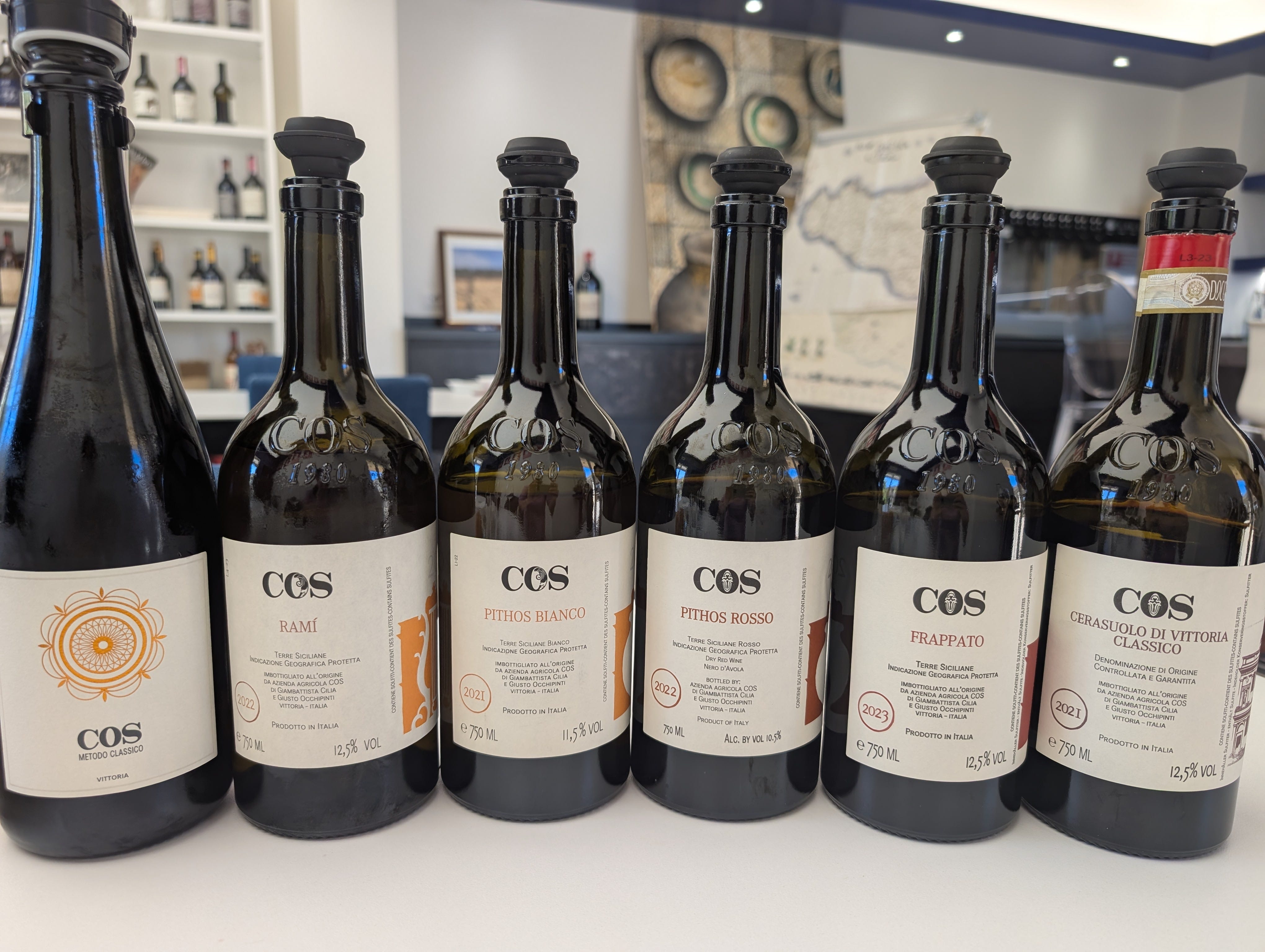
1) 2021 COS Spumante Frappato Metodo Classico Extra Brut - 100% Frappato, very small production, wine is produced from 2021 vintage but no additional sugar or yeast to achieve sparkling instead secondary fermentation uses the addition of fresh must of 2022, 20mo on lees, 2g/l residual sugar.
Pale pink. Bright acid, silky texture, wet stone minerality, perfumed violets, touch bitterness on finish offers complexity, pairs well with food given the high acid, bone dryness, and cleansing finish.
2) 2022 COS Rami Bianco - 50% Grillo & 50% Inzolia, First white wine for COS, classic Sicilian blend, 7 day maceration, 10 month fermentation and aging in concrete, intense golden color, deliberately oxidize wine in the beginning prior to fermentation, best seller - can find it anywhere around the world.
Toasted almonds, dried flowers, spiced pear, acid is high but integrated, easy drinking, finishes crisp and clean.
3) 2021 COS Pithos Bianco - 100% Grecanico, 10 days skin contact orange wine, 11.5% abv, beautiful golden hue, fermented and aged in amphora, unfiltered.
Structurally beautiful, ginger & apple skin, dried apricot, dried grass, sandy texture, orange zest on the finish.
4) 2022 COS Pithos Rosso - 100% Nero d’Avola, process described above.
Muted aromatics, light and elegant tannins, crushed Morello cherry, black licorice, rhubarb flavors, high integrated acid culminate in fresh clean finish.
5) 2023 COS Frappato - 100% Frappato
Fresh red fruits (strawberry, raspberry), light crunchy tannins, chalky midpalate, wet earth-laced finish.
6) 2021 COS Cerasuolo di Vittoria Classico - 40% Frappato, 60% Nero d’Avola
Medium ruby color, cranberry, dried cherry, sandalwood, smokey earth, firm tannins, fine structure, finishes with macerated plum and sea smoke. Good longevity and will gain in complexity as flavors meld and evolve.
7) 2022 COS Zibbibo in Pithos - 100% Zibbibo,
Crushed flowers, lemon, saline, high acid, with touch of lanolin, crushable. Porch pounder!