ARPEPE: Championing the Alpine Elegance of Valtellina Nebbiolo
ARPEPE
If Barolo is the King and Barbaresco is the Queen, then Valtellina is the Snow White of Nebbiolo, a royal princess often overlooked but every bit as regal.
 Castello Grumello. Source: Coppiera Travel Archives
THE REGION
Valtellina is a steep, narrow alpine valley carved by the Adda River in the Lombardy region of Italy, bordering Switzerland. It’s about 150 miles northeast of Turin, Piedmont, but it’s viticultural terrain is driven by its proximity to the Alps and is one of the most distinctive in the world. The vineyards are planted on south facing slopes which receive maximum sunlight and warmth despite the high mountain altitude. The valley’s treacherous slopes are so steep that vines grown on ancient dry-stone terraces (muretti a secco) built over centuries. These terraces climb up to 2,300 feet in elevation and are supported by 1,550 miles of dry stone walls.
In 2018, UNESCO recognized the global “Art of Dry Stone Walling” as part of an Intangible Cultural Heritage artifact of the world. This designation recognizes the centuries-old knowledge and techniques used to create the thousands of kilometers of stone walls, which allow for wine production on steep slopes, and have become a key part of the area’s identity and landscape. The walls are a testament to the harmonious relationship between human labor and nature, as they prevent landslides and erosion while shaping the land for agriculture.
VITICULTURE
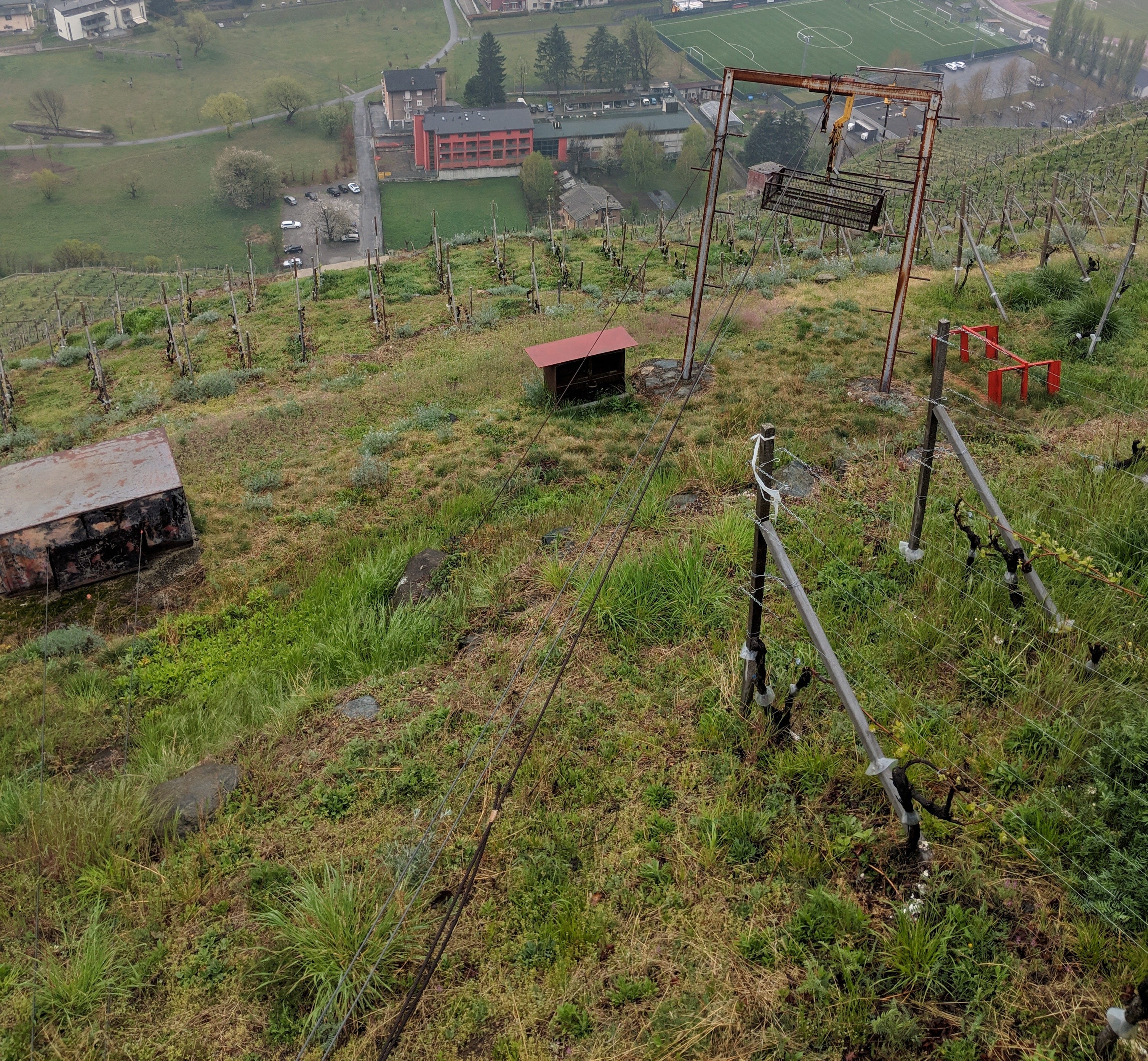
These vineyards are so steep, machines cannot be used for general tending to vines, everything is done by hand. Like the Mosel and Douro, funiculars and terracing are used to assist in harvesting and preventing erosion. When recultivating new plots ARPEPE uses a helicopter to drop manure onto specific sites. The mountain landscape also contributes to an alpine continental microclimate. The sunny days and cool nights create strong diurnal temperature that preserve acidity and aroma in the grapes. Winds from the mountains keep the air dry and reduce disease pressure while the snowmelt and glacial soils regulate water and minerals. This combination leads to wines which are aromatic, elegant, and ageworthy with freshness and poise rather than heavy or overripe.

The steepness can be an issue at harvest. You don't want to slide all the way down that hill. Source: Coppiera Travel Archives
CRUS
The main DOCG is Valtellina Superiore DOCG and is divided into five crus, each reflecting subtle variations in soil, exposure, and elevation:
- Sassella
- Grumello
- Inferno
- Valgella
- Maroggia
ARPEPE
“Il giusto tempo del Nebbiolo,” or “The right waiting time for Nebbiolo” for Arturo, the more Nebbiolo aged, the better it was. (Source: Skurnik)
ARPEPE (short for Arturo Pelizzatti Perego, pronounced AR-Pay-Pay) is a fifth generation family-run winery in Valtellina, renowned for its mountain-grown Nebbiolo. Founded in 1984, reviving a family estate that dates to the 19th century, ARPEPE specializes in long-aged, traditional wines that express the terroir of the Alps with exceptional finesse. The estate farms steep, hand-tended terraces around Sondrio and Grumello, using minimal intervention and long macerations in wood vats. Wines are aged slowly in large oak casks and bottle, yielding Nebbiolos that are delicate, perfumed, and deeply mineral, with notes of rose, herbs, and stone. ARPEPE is celebrated for combining classic craftsmanship with mountain purity, producing some of Italy’s most elegant and soulful expressions of Nebbiolo. The winery is widely recognized as the single best producer in the appellation!

Where is Valtellina Any Way? Source: Google Maps
AGEING
As you can see, the Rosso is aged for 6-9 months in wood and 6 additional months in bottle. The Valtellina Superiore sees 12 months in wood and 12 additional months in bottle. The Crus are aged for 3.5 years in wood comprised of Chestnut, acacia and oak usually 50 years old and 50 hectoliters and an additional 2 years in bottle before release.
THE WINES
Il Pettirosso - 100% Nebbiolo, 400/550 meters, yield: 45hl/ha, 101 day maceration in 50hl untoasted wood casks, rests 24 months in bottle before release.
Rosso di Valtellina - 100% Nebbiolo, 350/400 meters, yield: 50hl/ha, 30 day maceration in 50hl wooden vats, 6 months in 50hl vats, concrete and bottle.
Grumello Rocca de Piro - 100% Nebbiolo, 350/500 meters, yield: 45hl/ha, 108 days in 50hl wooden vats, 12 months ageing in 50hl, concrete, bottle.
Sassella Stella Retica - 100% Nebbiolo, 400/600 meters, yield: 45hl/ha, 103 day maceration in 50hl wood casks, 12 months ageing in 50hl, concrete, bottle.
Inferno Fiamme Antiche - 100% Nebbiolo, 450 meters, yield: 45hl/ha, 105 day maceration in 50hl wood casks, 12 months ageing in 50hl, concrete, bottle.
Grumello Sant’Antonio - 100% Nebbiolo, 450/500 meters, yield: 40hl/ha, 132 day maceration in 50hl wood casks, 42 months ageing in 50hl, stainless steel, bottle.
Inferno Sesto Canto - 100% Nebbiolo, 450 meters, yield: 40hl/ha, 137 day maceration in 50hl wood casks, 42 months ageing in 50hl, stainless steel, bottle.
Grumello Buon Consiglio - 100% Nebbiolo, 350/400 meters, yield: 40hl/ha, 138 day maceration in 50hl wood casks, 42 months ageing in 50hl, stainless steel, bottle.
Sassella Rocce Rosse - 100% Nebbiolo, 400/500 meters, yield: 40hl/ha, 133 day maceration in 50hl wood casks, 42 months ageing in 50hl, stainless steel, bottle.
Sassella Nuova Regina - 100% Nebbiolo, 450/550 meters, yield: 40hl/ha, 131 day maceration in 50hl wood casks, 42 months ageing in 50hl, stainless steel, bottle.
Sassella Ultimi Raggi - 100% Nebbiolo, 600 meters, yield: 30hl/ha, 114 day maceration in 50hl wood casks, 42 months ageing in 50hl, stainless steel, bottle.